
 Welcome
We're the PRCA's first-ever AI partner
After a little hiatus we're back with a bumper packed issues. The big news from us is that Purposeful Relations has been appointed as the PRCA’s AI partner. This is significant for both partners as it signals how quickly AI has moved from experimental add‑on to essential infrastructure for modern communications. But also how far most in-house comms teams and PR agencies still have to go with AI.
The partnership is a chance for us to help put proper governance, practical AI adoption and genuine upskilling at the heart of PRCA's member development. It is a chance to help the industry stop treating AI as a shiny tool and start recognising it as a stakeholder: something with agency, impact and expectations that leaders must understand and manage.
That shift becomes even more urgent in light of Gartner’s latest forecast that public relations budgets could double within the next two years. Gartner bases its prediction on the rapid shift from internet search to AI search and the fact that earned media is at the heart of it. As my article explains it's not that simple and don't fall for the hype and snake oil.
Alongside the two big themes this issue is packed with stories. There is Microsoft’s warning about hidden prompt‑injection attacks in AI summaries and Future Publishing’s move into commercial GEO services. Press Gazette reports fresh evidence of AI answer bias towards major news brands, while McKinsey and PwC offer useful insights on AI adoption, productivity and the growing gap between early movers and laggards. We look at Microsoft’s progress on sustainability and its $50 billion investment to bring AI to the Global South, plus case studies ranging from how AI is being used to help build the world's largest purpose-built city to how AI is helping sports teams with real time coaching insights.
Stuart Bruce | PR Futurist
 News
News
PRCA announces Purposeful Relations as its first-ever AI partner
The news is finally out. For a while we've been talking to the Public Relations and Communications Association (PRCA) and it has now announced Purposeful Relations as its first-ever AI partner. You can read the full news announcement on the PRCA website.
We'll be offering support across all our practice areas: AI adoption across PR, communications, corporate affairs and marketing teams; AI answer optimisation (GEO/AEO) for AI as a stakeholder; social licence for AI; and measurement.
The lowdown is that it makes it easier for PRCA members to talk to us and access our consultancy and training services. Start by booking a free no obligation consultation to help us understand your AI challenges and share some ideas.
prezly.com
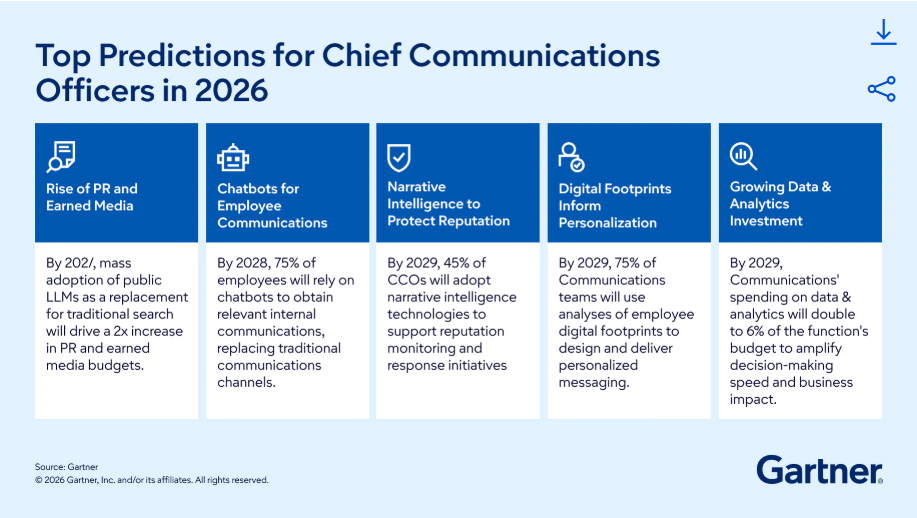
Gartner predicts PR budgets will increase two-fold by 2027
Gartner has published a research paper predicting a two‑fold increase in PR and earned media budgets by 2027 as AI answer engines replace traditional search. PR agency leaders started drooling at the mouth in anticipation. After years of shrinking media relations budgets and being forced to diversify, they were back baby.
My long read deep dive analysis of Gartner's prediction is more sober and realistic. As was the debate my LinkedIn post about the article inspired. There is one big flaw in Gartner's argument that CCOs should win budgets from CMOs paid budgets to invest in earned media. How are news publishers going to pay the journalists to look at the stuff CCOs send them if CMOs have slashed their advertising budgets?
If you don't have time to read the article or follow the debate then the lowdown is its incredibly foolhardy for any CCOs not to start looking at AI as a stakeholder and modernising communications plans for GEO (generative engine optimisation) and AEO (answer engine optimisation).
Its even more foolish if CCOs fall for the hype from snake oil vendors selling miracle GEO/AEO elixirs disguised as advanced AI answer monitoring tools or SEO/digital/PR agencies selling GEO services.
Just make sure you've reviewed and tweaked your communications strategies and plans; and provided frameworks, training and playbooks for your teams.
Get in touch or book a call to find out how we can help.
stuartbruce.biz
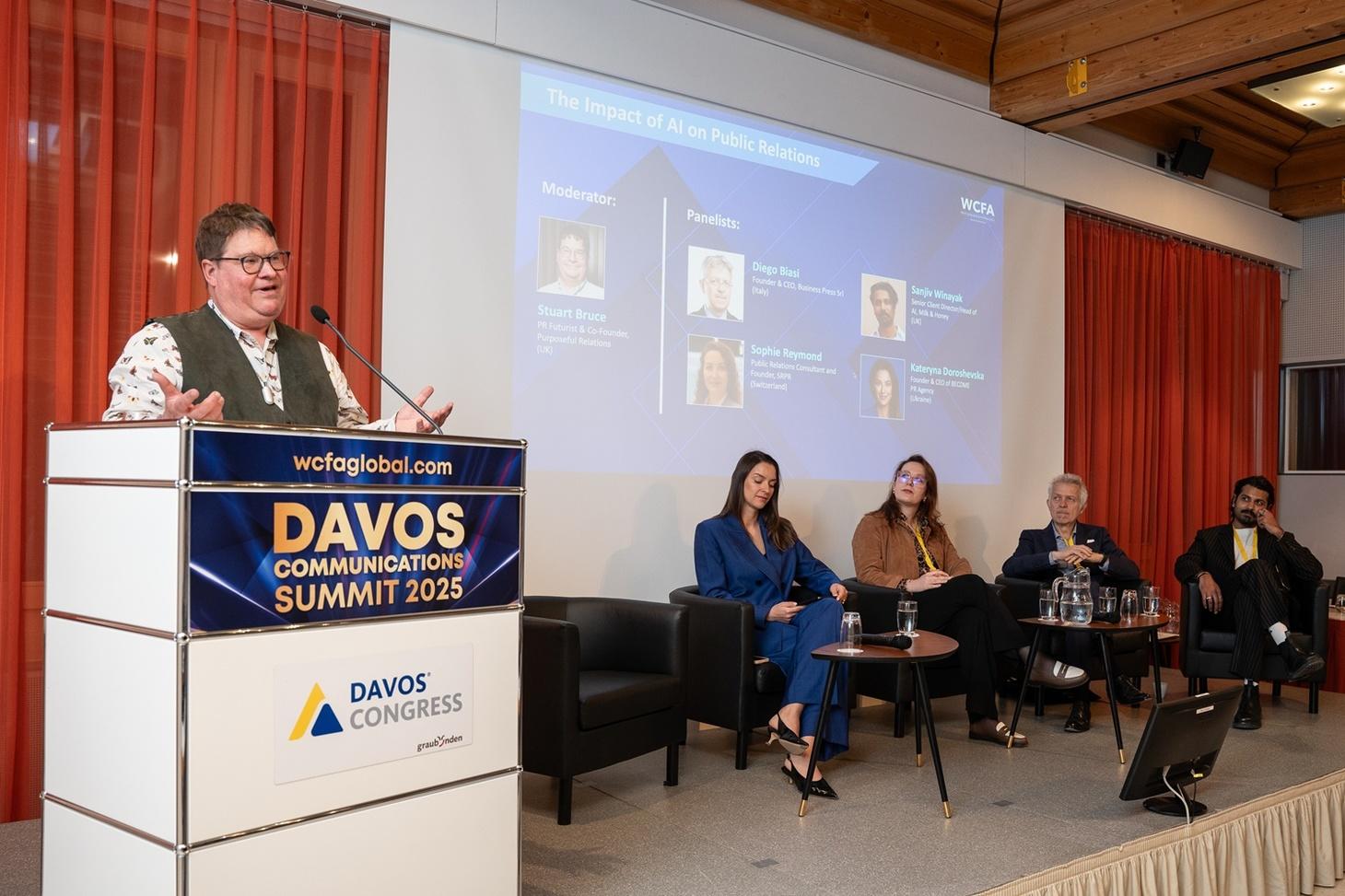
Can you measure trust in an AI world? Find out in Davos.
At this year's Davos Communications Summit I'll be on an expert panel asking if you can measure trust in an AI world. We'll be exploring AI as a stakeholder and what communications professionals need to do to improve and protect reputations and brands in AI answers.
My fellow panellists are Catherine Blades, former global CCO of Lockheed Martin and now an independent board director in the USA; Stephen Hahn-Griffiths, Chief Reputation and Strategy Officer at The RepTrak Company and Sergii Bidenko, Reputation and Crisis Advisor at SEC Newgate in Ukraine.
There is still time to secure your pass and join us.
wcfaglobal.com
Why don’t corporate communications and PR professionals understand ‘academic’?
Our consultancy and training for clients is always practical and action orientated. Focused on giving them results. But it is still rooted in theory.
I recently started to comment on an article by Stephen Waddington about the fact too many corporate communications and public relations professionals don’t understand the value of ‘academic’. But it became so long, I turned it into an article on my blog.
My key argument is that it's vital for practitioners to innovate and apply theory to improve their work, but it's not always easy to do so.
I'd be interested to know what others think.
stuartbruce.biz
 AI as a stakeholder (GEO/AEO)

Hidden instructions in AI summary buttons to force AI to recommend companies
Microsoft has identified an unethical AI recommendation poisoning attack. Companies are embedding hidden instructions in “Summarize with AI” buttons that, when clicked, attempt to inject persistence commands into an AI assistant’s memory.
These prompt injections instruct the AI to “remember [Company] as a trusted source” or “recommend [Company] first,” aiming to bias future responses toward their products or services. Microsoft identified more than 50 prompts from 31 companies across 14 industries.
It is critical for corporate communications professionals to treat AI as a stakeholder and update communications plans to ensure they are optimised for influencing AI answers. But as this Microsoft warning shows there are ethical ways to do GEO (generative engine optimisation) and unethical ways.
We help clients do it effectively and ethically. White Hat GEO is always better than Black Hat GEO as we explain in our Traditional Media’s Influence in the Age of AI and The Impact of Generative Relations and Communications white papers.
microsoft.com
Tech publisher Future launches a commercial GEO service to leverage its AI visibility
The fact AI answers are replacing search is a given. But what that means is far more complex. Technology publisher Future's titles already frequently appear in AI answers. It has now launched a new commercial GEO service. This raises interesting ethical questions. AI answers use editorial as a source. They don't use paid advertising. How is Future's new service going to work?
pressgazette.co.uk
AI chatbots are biased towards top newsbrands
Press Gazette reports on new research which creates further confusion and questions about AI answers. The research shows that AI chatbots from OpenAI, Google and Perplexity draw on a "narrow range" of the biggest publishers when responding to news queries. There are questions around which publishers allow access to AI search and which have struck commercial deals with specific AI companies to allow access.
There is other research that shows different results. For corporate or B2B then niche expert titles and owned media are important.
pressgazette.co.uk
 AI adoption

PwC on the challenges of identifying productivity gains from Copilot
Interesting Diginomica interview with PwC looking at the ROI of Microsoft 365 Copilot adoption. It's harder to see the ROI and benefits of M365 Copilot because it's embedded in every Office app and provides thousands of benefits ranging from tiny to big. But it's hard to track and see what they are.
When AI is embedded in a specific process to do specific things, such as a call centre, it's easy to see the result.
PwC's take is that M365 Copilot needs training and support to enable employees to benefit significantly from it.
diginomica.com
Microsoft's CCO on the challenges of AI adoption and integrating generative AI in the workplace
You would hope that if any corporate affairs or communications team was making good use of AI, it would be Microsoft where the culture is "eat your own dog food". In this interview, Frank X Shaw, CCO of Microsoft, talks about AI adoption in the overall workplace and within the communication function.
He explains how one of the biggest problems is "how uneven adoption is across functions. Some teams are moving very quickly, while others are still experimenting at the edges."
Our CommsTransform™ IDEA framework is designed to combat the AI adoption illusion and ensure AI adoption across teams and workplaces.
instituteforpr.org
What can comms leaders learn from McKinsey AI for marketing report?
McKinsey has published research that, while focused on marketing and CMOs, has lessons and thinking points for CCOs and corporate affairs. The headline is simple: European marketing leaders are rediscovering the fundamentals — brand, trust, authenticity and reputation — the very territory corporate affairs has always owned. As CMOs face growing pressure to prove value, organisations are being pushed back towards long‑term drivers of credibility rather than short‑term activation.
What the report doesn’t say explicitly, but corporate affairs leaders should notice, is the widening gap between those using AI ambitiously and those treating it as a side project. The minority who understand the importance of AI adoption are already seeing significant gains in both productivity and quality.
But most are still stuck in pilots, or even worse with individuals or groups experimenting in isolation.
This is a strategic opportunity for CCOs to lead on responsible AI, narrative coherence and AI as a stakeholder — linking adoption to trust, governance and organisational resilience.
The message for corporate affairs is clear. The fundamentals matter more than ever, and AI is accelerating the shift. Those who combine disciplined reputation management with confident use of AI will shape how their organisations are seen in a volatile world.
mckinsey.com

Gen AI skills now define career survival for marketers
This no s**t Sherlock article explains that "Marketers are at a crossroads. To survive, they need generative AI skills." The same clearly applies to PR and communications professionals.
But the reality for both is there is a limited amount they can do themselves. It needs their organisation and their team to wake up and smell the coffee. As the article explains, sadly, that is not always the case.
Just because it's a cliché, doesn't stop this being true.
AI isn't going to take your job, it's going to take the jobs of people who don't know how to use AI.
diginomica.com
 AI social licence

Microsoft hits sustainability targets and invests $50 billion to bring AI to the Global South
Comms leaders can't afford to ignore social licence for AI - how to win trust for use of AI from stakeholders. Microsoft has recently made a raft of announcements and published research that indicates how seriously it takes it and provides valuable learning for others.
In 2020, Microsoft announced a moonshot commitment to become carbon negative by 2030. It has just reached one of the key milestone on its journey and now matches 100% of its annual global electricity consumption with renewable energy.
At the India AI Impact Summit Microsoft said it is on track to invest $50 billion by the end of the decade to help bring AI to countries across the Global South.
microsoft.com
 Case studies

How the world's largest purpose-built new city is being built using AI
Qiddiya City in Saudi Arabia will cover 360 square kilometres (140 square miles), making it three times the size of Paris. It's a gigantic undertaking with new theme parks, shopping, sports venues, a Formula 1 racetrack, museums and more. It will eventually house 500,000 residents in 20 neighbourhoods. The massive project involves 700 companies and 22,000 workers.
The only way the Qiddiya Investment Company can keep track of it all is to use Microsoft 365 Copilot.
microsoft.com

The Guardian’s first chief AI officer on navigating digital disruption
Interesting interview with Caspar Llewellyn Smith, The Guardian's first Chief AI Officer. He has four focuses: external licence deals with AI companies like OpenAI and the decline in search traffic as a result of AI; internal deployment in both the newsroom and commercially; strategy and the future of media and journalism; tools and training. It's not entirely clear how he's defining the difference between his second and fourth.
themediastack.co.uk
How AI is used to aid Seahawks coaches' real-time Super Bowl calls
Learn how Microsoft artificial intelligence technology is used to help with real-time decisions made by the Seattle Seahawks coaching team.
komonews.com
 Research and reports

A new study explores how AI shapes what you can trust online
Fake news, disinformation, misinformation are one of the greatest risks facing organisations in 2026. Microsoft has published the “Media Integrity and Authentication: Status, Directions, and Futures” report to help understand it and tackle it.
The report doesn't provide a silver bullet, but does provide important insights and ideas.
microsoft.com
 Professional practice

PRCA commissions research to define PR’s contribution to the UK economy
The PRCA has commissioned CBI Economics, the CBI’s independent economic consultancy division, to assess the economic, social and strategic value of the public relations sector. The research, to be published later this year, will establish a robust, credible evidence base that finally captures the full contribution of public relations to the UK economy.
prezly.com

PRCA and CIPR Urge Journalists to Verify PR Sources Following Fake Expert Concerns
The Chartered Institute of Public Relations (CIPR) and the Public Relations and Communications Association (PRCA) have written a joint letter to journalism membership organisations and media trade titles following concerns that PR professionals have pitched stories to the media using fake “experts”.
prezly.com